
Fast Forward Signals · Episode 04
AI in Corporate Communications: It's No Longer About Producing More
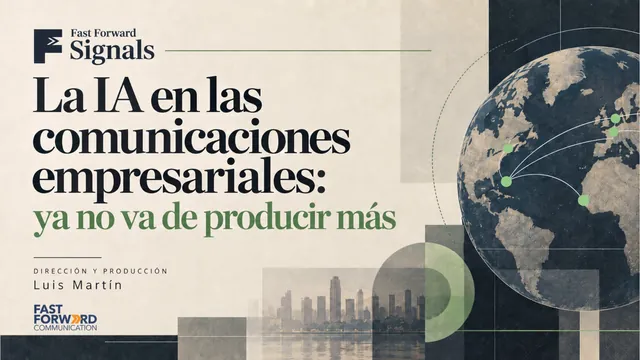
La IA en las comunicaciones empresariales: ya no va de producir más
Illustrated editorial video podcast on artificial intelligence, reputation and judgment in corporate communications, narrated in Spanish.
Illustrated office scenes connect AI dashboards and synthetic company profiles with a duplicating press. One more sheet rolls out before the focus shifts to editorial judgment and executive accountability. The video closes by returning to the green dashboard.
The episode
Spanish audio. Spanish, English and Catalan subtitles; transcripts in all three languages. The English and Catalan versions are editorial adaptations of the Spanish narration.
Artificial intelligence disclosure: The Spanish narration in this episode is a synthetic voice generated under human editorial direction from the text written by me, Luis Martín, the author of the piece. It does not imitate or replicate any real person.
Movements
- The Green Dashboard and the Unapproved Summary
- The Company as Raw Material
- Synthetic Reputation: Visibility and Credibility
- From Abundance to Editorial Judgment
- Accountability and Corporate Governance
- The Green Dashboard: Answering for It
Read the transcript — English editorial adaptation
The communications director arrives Monday morning, opens the monitoring dashboard, and finds everything looking in order. The metrics are within range. Social conversation is quiet. Sentiment sits in that reassuring shade of green everyone likes to put on large screens.
Then someone asks a much less sophisticated question: “What does ChatGPT say about us?”
Ten seconds later, a summary appears that no one in the room approved. It blends the official company description with a three-year-old controversy, two recent news stories, and other people's conclusions.
The dashboard is still green.
Our reputation, perhaps less so.
For decades, corporate communications ran on a predictable model. The company put out a message, sent it through its channels, then watched what happened.
Generative AI changes that architecture at its foundations.
The real disruption is not that we can write a press release in thirty seconds. It is that a growing share of customers, analysts, and investors will form an opinion of our company without ever visiting its press room.
The model reads for them.
In the process, the organization is no longer just the sender. It becomes the raw material for the story.
This is probably the subtlest shift: reputation now has a synthetic layer.
Different models build materially different profiles of the same company. They don't weigh the same sources or apply the same criteria.
There is no single “AI version” of your brand.
And visibility is no longer the same as credibility.
A company can appear often in a machine's answers and still fail to sound convincing to the people reading them.
We used to fight to be found.
Now we have to be understood—and, above all, believed—even when no one quotes us directly.
AI has drastically lowered the cost of producing polished copy, flawless images, and tailored speeches.
But when production stops being scarce, it stops setting anyone apart.
If any department can turn out fifty pieces before lunch, the advantage cannot be producing a fifty-first.
Value moves to what cannot be generated in bulk: judgment, editorial intent, and knowing what not to publish—with the resolve to act on that judgment.
Execution gets cheaper. Judgment gets more expensive.
Abundance does not end the need for communications. It ends the premium we once paid for the mechanical work of producing it.
There is a familiar temptation when confronting these changes: to fall back on “the human factor will matter more than ever.”
It is comforting. It is also misleading.
We do not need people in the loop for sentimental reasons.
We need them because someone has to answer for what is said.
A machine can draft the reply, predict its impact, and monitor the landscape.
What it cannot do is stand behind an ethical position or take responsibility for the consequences of a mistake.
That is not nostalgia.
It is corporate governance.
The Monday dashboard will stay green.
Someone still has to answer for what the algorithm has just said about us.
Other languages
Technical sheet
Summary and metadata
| Title | AI in Corporate Communications: It's No Longer About Producing More |
|---|---|
| Author | Luis Martín |
| Published | September 24, 2026 |
| Format | Editorial video podcast · Six illustrated movements |
| Production | Approximately 70 hours of specialized production work, excluding research and editorial writing. |
Editorial origin: the article “AI in Corporate Communications: It's No Longer About Producing More” in Readings · updated September 2026.
Master specifications
| Duration | 03:38.633 |
|---|---|
| Picture | 1920 × 1080 · 16:9 |
| Frame rate | 30 fps constant · 6559 frames |
| Video | H.264 High / yuv420p |
| Audio | AAC-LC · 44.1 kHz · stereo · Spanish |
| Music, sound effects and ambience | None |
Subtitling and accessibility
Three external WebVTT tracks: Spanish, English and Catalan, 66 cues each. Off by default and user selectable; neither burned into the picture nor muxed into the container.
Spanish audio. Spanish, English and Catalan subtitles; transcripts in all three languages. The English and Catalan versions are editorial adaptations of the Spanish narration.
Synthetic narration under human editorial direction, as disclosed alongside the video.
Methodological workflow
Text by Luis Martín, developed into six illustrated movements on a single timeline with Spanish narration. The English and Catalan editorial adaptations provide written access to the same essay. Subtitles and transcripts accompany the audiovisual master.
You can also listen to this podcast on your favorite platform.