
Guide · No. 04 · Get your brand told right, away from home
How to get AI to find your brand—and describe it accurately—beyond your own website

Your site says who you are. AI search also listens to what everyone else says. This guide shows how to find out which sources the systems consult, correct stale information, and build an external presence that helps your brand show up with more accuracy.
Years ago, before you booked a restaurant in a city you didn’t know, you could do something fairly crude: ask at the hotel front desk.
The clerk hadn’t cooked the risotto. He didn’t know the margins. He hadn’t sat through the owners’ meetings, and he almost certainly hadn’t read the mission statement someone wrote with such feeling for the website. But he knew things. He knew which place guests kept recommending, which one was always full, which had changed hands, and which had started drawing cooler comments even as its photographs still showed the same impeccable tables.
The restaurant could have an impeccable website. Its version.
The clerk had something else: outside context.
AI search introduces an extraordinarily sophisticated version of that scene.
When someone asks ChatGPT, Gemini, Perplexity, Google AI Mode, or another system for a good florist, which tool is worth buying, or which firm actually works in a given specialty, the answer can rest on many different sources. The company’s own website is among them, of course. But so are trade publications, comparison pieces, reviews, directories, communities, professional profiles, videos, and other pages the company does not control.
From your website to reputation. From the official fact to outside corroboration. From what you say you are to what the world out there appears to confirm.
That is where this tutorial begins.
The idea to understand before you do anything
In plain English: it is not enough to have your website in order if, away from it, the internet tells another story about your company.
Imagine your page says you work mainly with industrial firms, but three directories still describe you as an agency for restaurants. Or you dropped a service two years ago and a widely cited comparison still insists you offer it. Or you have changed your pricing model completely, yet an old review keeps turning up in an AI answer.
This is not only a positioning problem.
It is a representation problem.
A few recent studies help size the phenomenon, though their numbers deserve to be read with care.
In May 2026, Muck Rack analyzed more than 25 million links present in answers from ChatGPT, Claude, and Gemini, across 17 sectors, and classified about 84% of those citations as earned media. That does not mean “84% of everything an AI says comes from third parties.” It means exactly what that study measured, inside that sample, with that classification.
AirOps reached a similar result from another angle. In an analysis of 21,311 brand mentions drawn from more than 500 commercial discovery queries, 85% of the mentions were attributed to external domains and 13.2% to the brand’s own domain. The study, moreover, focused on commercial discovery queries. It is not, therefore, a universal ratio for every question or every sector.
Peec AI, for its part, studied 30 million sources cited in the United States by ChatGPT, Gemini, Perplexity, Google AI Mode, and AI Overviews. In its March 2026 analysis, Reddit, YouTube, LinkedIn, and Wikipedia appeared again and again, alongside review sites and specialized publications. But the differences between platforms and sectors were considerable.
Three investigations.
Three methodologies.
Three photographs of the same landscape, taken from different windows.
Don’t add the percentages together. Don’t turn them into dogma. Keep the pattern: external sources matter, and the various AIs do not necessarily consult the same ones.
What the studies actually say
| Study | What it analyzed | Relevant finding | What it does NOT prove |
|---|---|---|---|
| Muck Rack, 2026 | More than 25 million links in answers from ChatGPT, Claude, and Gemini | About 84% of the citations studied were classified as earned media | That 84% of every AI answer comes from third parties |
| AirOps, 2026 | 21,311 brand mentions in commercial discovery queries | 85% came from external domains | That the same ratio holds for any query |
| Peec AI, 2026 | 30 million sources cited across several systems | Certain domains appear often, but they change by system and sector | That there is a universal list of AI’s “favorite sources” |
And a warning before we go on.
This technology moves very fast. Retrieval systems, indexes, models, interfaces, and preferred sources can change without your strategy changing a comma.
This tutorial reflects what we can verify as of September 29, 2026.
If you come back in a few months, come back to our guides as well. We will update them as the ground shifts.
Step 1. Start with the questions, not the platforms
This is where it is easy to go wrong.
You see that Reddit shows up a lot in a study and think: “We need to be on Reddit.”
Not necessarily.
A dental clinic in Marbella, an accounting-software company in Mexico City, and an industrial engineering firm in Lima are not competing for the same sources of information. Their clients do not ask the same questions, either.
That is why the starting point should not be “Which platforms should we open profiles on?” but something much simpler:
What would someone ask an AI if they were looking for precisely what we offer?
A working example.
A web-development agency might run into questions such as:
“Which firms build corporate websites for law offices?”
“Which agency can rebuild a complex site without WordPress?”
“Which providers handle brand strategy and web development under the same team?”
A tourism company would have others.
An industrial manufacturer, others entirely.
Don’t obsess, at the start, over writing the perfect query. Think the way an ordinary person would think—someone who does not know your company yet.
The shift looks minor. It changes everything.
You are no longer trying to “optimize for ChatGPT.”
You are trying to understand which ecosystem of sources appears when a person asks the questions that matter for your business.
Step 2. Run the searches yourself
Open the systems that are relevant to your audience and ask those questions.
Then look at two different things: which brands appear, and which sources support the answer.
Don’t assume a result will be identical tomorrow. Generative answers can vary by system, model version, date, how the query is phrased, what information is available at that moment, and other factors.
That is why a single search is a clue.
Not a verdict.
Run several representative queries. Repeat them periodically. Compare them.
With a spreadsheet open beside you.
Yes. A spreadsheet.
Put simply: for each query, note the question, the system used, whether your brand appears, which other companies appear, which domains are cited, which specific pages support the answer, and whether the information about your company is correct, incomplete, or simply wrong.
You don’t need a dashboard with twenty charts to begin.
You need a memory.
Because in three months you will want to know whether anything changed.
Your minimum log
| Query | System | Does your brand appear? | Source cited | Competitors | Information correct? | Date |
|---|---|---|---|---|---|---|
| “Real client question” | ChatGPT | Yes / No | URL or domain | Brand A, Brand B | Yes / Partial / No | mm/dd/yyyy |
Step 3. Build your source map
After a few queries, something interesting will start to happen.
Some domains will repeat.
A trade publication may appear in four different answers. G2 may dominate queries in a particular software category. Clutch may keep turning up when agencies are compared. In travel, Booking.com, Tripadvisor, or YouTube may carry the weight. For a local business it could be Yelp or a regional publication.
That pattern is worth far more to you than any global ranking of “the websites AI cites most.”
Your aim is to end up with something like a map.
Not “the internet.”
Yours.
The twenty, thirty, or fifty pages a person is likely to find—directly or through an AI—when they research your category.
From there you can stop shooting in the dark.

Step 4. Fix first what you can actually control
Some external sources, even though they do not live on your domain, let you administer the company information directly.
LinkedIn is the most obvious example. G2, Capterra, Trustpilot, GitHub, professional directories, or platforms specific to your sector may also matter.
Don’t collect profiles for the sake of it.
Open them, or keep them, when they serve a real function for your business or appear repeatedly among the sources used for your queries.
On those listings, five things should match reality:
- who you are;
- what you do;
- whom you do it for;
- where to find your official website;
- which products or services exist today.
A useful subtlety appears here: consistency does not mean pasting the same paragraph onto twenty sites.
It means the facts do not contradict one another.
You can explain the company one way on LinkedIn and another way in a specialized directory.
In our own case, for example, there is not much sense in being a “strategic communications consultancy” on one site, a “digital advertising agency” on another, and a “software-development company” on a third if those differences do not match the facts.
The wording can breathe.
The facts should survive cross-examination.
Step 5. Read the reviews without trying to manufacture a reputation
Reviews pose a different problem because, by definition, they are not yours.
That is precisely part of their value.
Look at what clients say.
Not only how many stars they leave.
Which services do they mention? What kind of client do they appear to represent? What problems do they say you solved? Do they talk about features that no longer exist? Do they confuse you with another company? Do they repeat a particular strength that your own website barely explains?
A reviews page can hold a formal company description and, underneath it, fifty small pieces of human evidence.
That interests people.
And it can interest the systems that retrieve information from those pages.
What you should not do is try to tame that material with fake reviews, covert campaigns, or staged participation.
Reddit, for instance, forbids spam and expressly lists as possible violations repetitive posting for exposure or commercial gain, and certain forms of unwelcome promotion.
Without the jargon: do not open a Reddit account so you can leave crumbs with your company name as if you were feeding an algorithmic pigeon.
If you have something useful to add, add it.
If you don’t, listen.
Step 6. Look for the comparisons AI uses again and again
This is often where one of the more interesting opportunities hides.
Suppose you ask several times which tools are best for a given task, and three different systems cite the same comparison article.
Your company is not in it.
The first impulse may be to write the editor:
“Hi, could you include us?”
There is a considerably better approach.
Read the article.
Check when it was last updated. Find out what criteria it uses. Look at which competitors appear, and why. If the publication explains how it selects products or vendors, respect that process.
Then ask yourself what you could offer that would actually help update the piece.
Original data.
A specification that has changed.
Current prices.
Original research.
A new use case.
An expert source.
Verifiable information that makes the article better.
A request for inclusion mainly benefits the person making it.
A good fact can benefit the article.
Editors notice the difference.
Step 7. Don’t abandon your own house
By this point it may sound as if we are saying your website no longer matters.
Quite the opposite.
Your site should be the official source anyone can consult to find out what is true today.
Correct company name. Current products and services. The audience each offer is for. Features. Terms. Prices, when they should be published. Locations. People responsible. Original research. Material changes.
The easier a fact is to verify, the easier it is to correct when it appears wrong elsewhere.
Think of your website as the brand’s civil registry.
Other sources can tell stories about you.
Here, the facts should be checkable.
And there is a small technical check worth doing even if you do not have a technical background.
To appear in certain AI search experiences, your pages first have to be reachable by the relevant systems.
In OpenAI’s case, OAI-SearchBot is involved in ChatGPT Search’s access to public content. Blocking it can keep a page from being used as a source in search results. Allowing it, of course, does not guarantee that you will appear.
At Google, AI features rest on the ordinary indexing and eligibility requirements of Search; Google does not require a special markup reserved only for AI Overviews or AI Mode.
Translated for someone who does not want to spend the afternoon reading a robots.txt file:
ask the person who maintains your site to confirm that the search engines and AI services you care about can reach the pages you want to make public.
That is all.
You don’t need a master’s in infrastructure.
Step 8. Build a small system for correcting errors
Imagine you find an important comparison that still lists your 2024 price.
Don’t just think “what a nuisance.”
Document the error.
Find the official source that shows the correct figure.
Identify whether the page has an editor, an update form, an administrable profile, or a support desk.
Ask for the correction in a sentence considerably less dramatic than “artificial intelligence is spreading false information about our brand.”
Something like:
“We noticed this page still shows our previous price. The price in effect since such-and-such a date is this, and it can be verified here.”
Fact.
Figure.
Source.
The less friction there is in verifying your correction, the better.
And record the date.
That last detail feels bureaucratic until you have been doing this for six months and cannot remember whether you already wrote to that publication or merely thought you should.
Corrections log
| Source | Error found | Correct fact | Official evidence | Action | Date | Status |
|---|---|---|---|---|---|---|
| Comparison X | Old price | Current price | Official URL | Editor contacted | mm/dd/yyyy | Pending |
The aim is not to turn you into an archivist.
It is to keep the same error from surprising you three times.
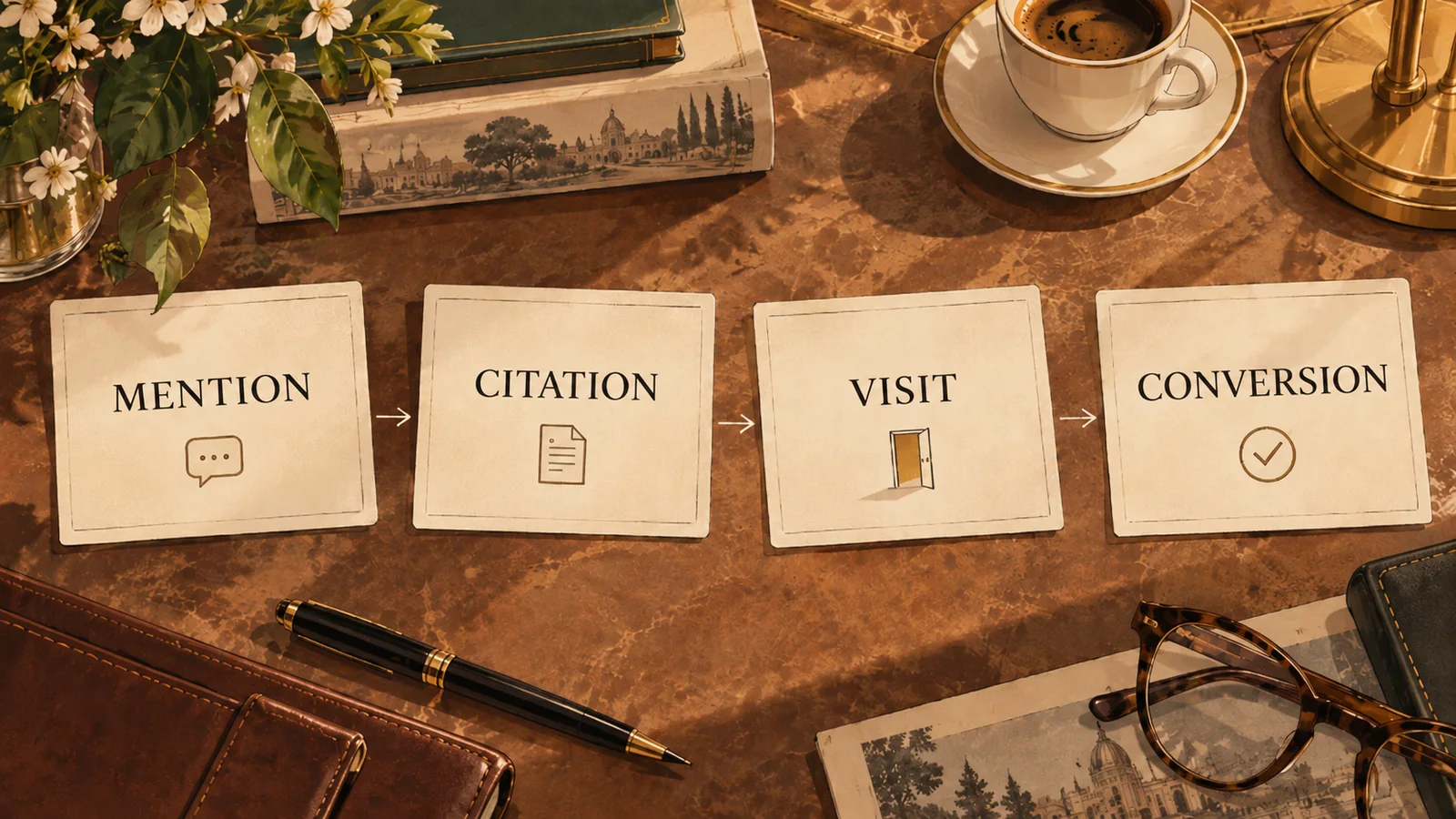
Step 9. Measure mentions, citations, and traffic as different things
That an AI mentions your brand does not necessarily mean it cites your website.
That it cites your website does not mean anyone clicks.
And a click is not a sale.
From presence to citation.
From citation to visit.
From visit to conversion.
Don’t mix those layers.
That last point matters.
Because it is tempting to hold up a screenshot of ChatGPT mentioning a brand and call it a “result.”
It is not necessarily one.
It is a data point.
It can be a magnificent data point.
But it is still a data point.
Step 10. Don’t turn “GEO” into a new religion

There is already a whole industry around terms such as Generative Engine Optimization, GEO, or AEO.
Some of its techniques are perfectly sensible.
Others are ordinary SEO in a new suit.
And others, frankly, look like alchemy.
The available evidence does not justify believing there is a secret formula capable of forcing an AI to cite a brand.
That does not mean you should ignore the shift.
It means you should work on things considerably less exotic:
clear information;
useful research;
reputable sources;
sound technical accessibility;
legitimate external presence;
content worth citing;
and a brand that can be described without anyone having to guess what on earth it sells.
None of that fits neatly into a magic formula.
All of it, however, is within your reach.
The reality check
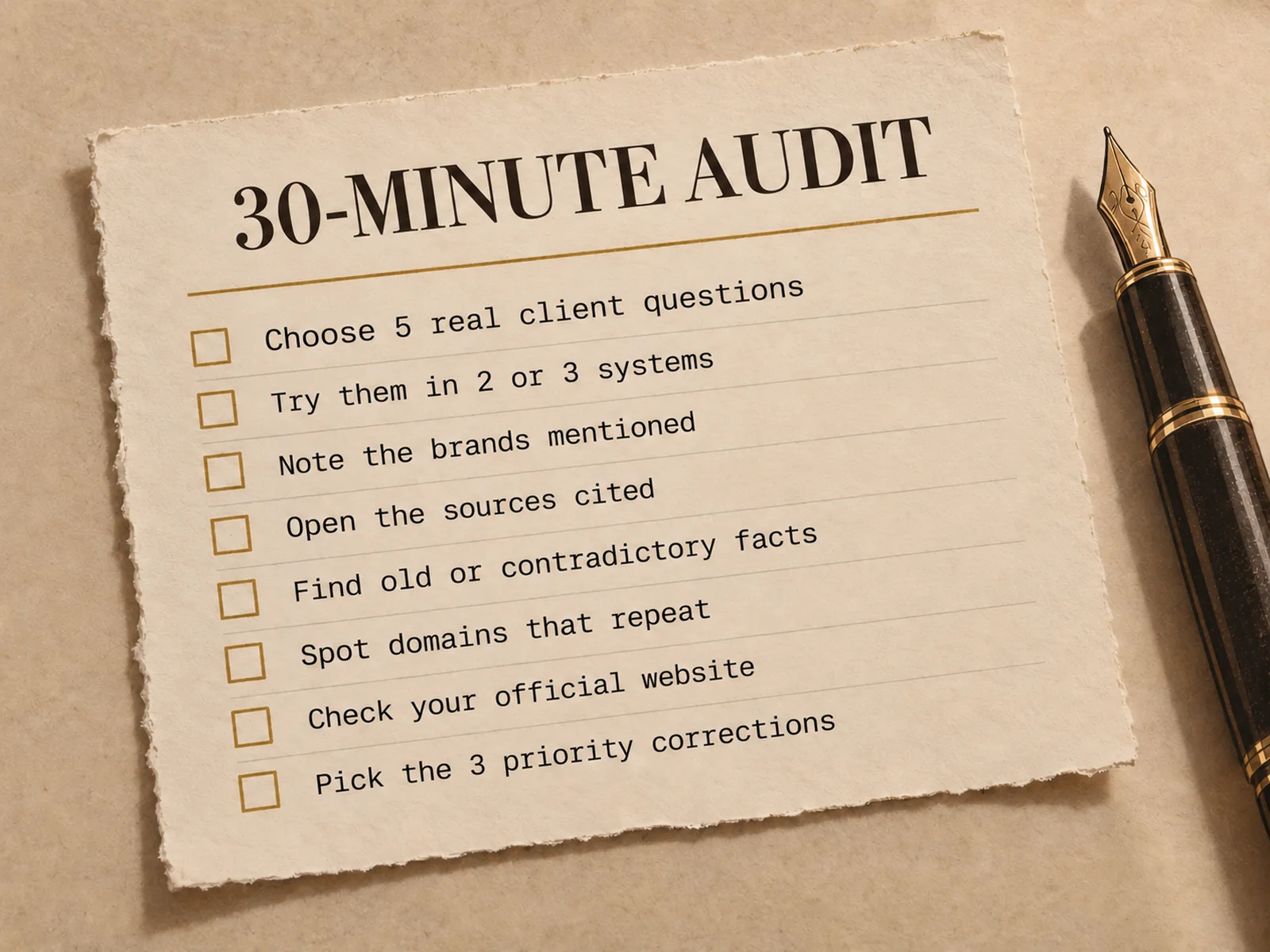
If tomorrow you want to know where to start, run this test.
Pick five questions a prospective client might ask before hiring a company like yours.
Ask them in two or three AI systems relevant to your market.
Open the sources that appear.
Look for your brand.
Look for your competitors.
Check which information repeats.
Then visit those pages as a person, not as a “GEO specialist.”
Would you understand correctly what your company does?
Are the facts still current?
Are the comparisons reasonable?
Is there a source that keeps appearing and that you have ignored for years?
There you have work to start with.
You don’t need a theory of how an AI thinks.
You need to observe what it is reading.
30-minute audit
- Choose 5 real client questions
- Try them in 2 or 3 systems
- Note the brands mentioned
- Open the sources cited
- Find old or contradictory facts
- Spot domains that repeat
- Check your official website
- Pick the 3 priority corrections
Three things not to forget
Your website remains your company’s official source.
External sources can shape how your brand is discovered and described, especially in certain comparison and discovery queries.
And no presence, profile, review, article, or technical tweak guarantees that an AI system will mention you or cite you.
That last point is worth repeating, because around this technology a healthy industry of promises will grow—is already growing.
AI search is not a vending machine.
You don’t insert three brand mentions and receive a recommendation.
It is a shifting ecosystem of indexes, models, sources, queries, and retrieval criteria.
The strategy, then, looks less like “optimizing an AI” and more like something good organizations have been doing for decades:
making sure the correct information about them exists, can be checked, and appears in the places where people go to find answers.
The only difference is that now, at times, the first reader is a machine.
Share
- Facebook (opens in a new tab)
- The native share sheet will open; choose Messages.
- LinkedIn (opens in a new tab)
- Reddit (opens in a new tab)
- Telegram (opens in a new tab)
- WhatsApp (opens in a new tab)
- X (opens in a new tab)
Frequently asked questions
What exactly is a third-party source?
It is any source outside a company’s official website that publishes information about it.
It can be a review, a comparison, a news story, a trade publication, a community, a directory, or even a company profile hosted on another platform.
The key is less who can edit the page than the fact that the information lives off your own domain.
Do I need to be on Reddit to appear in AI answers?
No.
That Reddit ranks among frequently cited sources in certain studies does not mean every company should have a presence there.
First check whether Reddit actually appears in the queries that matter for your business.
If it doesn’t, you may have better priorities.
Should I create profiles on every platform I can find?
No.
An abandoned or contradictory profile can produce more noise than value.
Prioritize the places where your clients are already looking for information, where sources relevant to your queries appear, and where you can keep the facts current.
Should my description be identical everywhere?
No.
The facts should be consistent; the wording does not have to be.
A LinkedIn description can differ from the one used on G2 or in a professional association, so long as name, activity, services, audience, and the rest of the factual information do not contradict one another.
Will more external mentions make ChatGPT recommend my company?
There is no demonstrated automatic relationship of that kind.
A stronger legitimate presence in relevant sources can improve the amount and quality of information available about a brand. But no number of mentions guarantees a recommendation, a citation, or a particular place in an answer.
Can I pay to appear in comparison articles?
Some publications offer sponsored content or commercial formats; others do not.
If there is a commercial relationship, it should be identified as such.
From the point of view of this guide, the important thing is not to confuse a paid appearance with independent evidence about the company.
What do I do if an AI gives wrong information about my business?
Start by looking for where the fact may have come from.
Check your own website, then the most visible external sources for that query.
If you find a page with outdated information, correct it directly when you control it, or ask the publication’s editor to update it.
It will not always be possible to identify the specific source that originated a claim.
Should I allow OAI-SearchBot?
If you want public pages on your site to be discoverable and usable by ChatGPT Search, it is worth checking that you are not blocking it by accident.
That does not mean OpenAI will display your content.
It only means you have not technically closed that route of access.
Always check OpenAI’s current documentation before changing crawl rules, because these specifications can change.
Do I need an llms.txt file?
As of September 29, 2026, we would not treat it as a universal requirement for appearing in generative systems.
It can be used experimentally in certain contexts, but there is not a sufficient basis for presenting it as the equivalent of robots.txt, or as a standard mechanism the major AI engines are bound to respect.
If you decide to implement it, treat it as a complement and verify each service’s current documentation first.
Do I have to create “content specially for AI”?
Not necessarily.
Good content for a person often shares many qualities with a good source for search systems: clarity, verifiable information, a readable structure, original data, context, and currency.
What does change is the need to think beyond your own website.
Your content can be impeccable and still live alongside external information that says something else.
How do I know if any of this is working?
Don’t rely on a single metric.
Watch, separately:
- whether your brand appears in relevant queries;
- which sources are cited;
- whether the accuracy of the information changes;
- whether those sources generate visits;
- and whether those visits produce business results.
A handsome screenshot is not a substitute for a time series.
How often should I repeat the audit?
There is no universal frequency.
For a stable company, a quarterly review can be a reasonable starting point. In markets where prices, products, regulation, or competitors change often, you will probably want to look sooner.
What matters is repeating a comparable set of queries so you can tell a real change from a passing impression.
Will this guide still be valid a year from now?
The underlying strategy will probably age better than the specific tactics.
Keeping information accurate, understanding external sources, and publishing useful evidence are fairly durable principles.
The crawlers, interfaces, reports, metrics, and systems the platforms use can change quickly.
That is why we recommend returning to these guides from time to time and checking whether an updated version exists.
Want to know what AI is reading about your brand?
We can audit how your company appears in ChatGPT, Gemini and Perplexity, find where what they say is published, and flag information that is contradictory, missing, or out of date. If you have a website, we also take a preliminary look against current standards. You get it all in one prioritized report.
The audit costs US$60 plus applicable taxes, or the equivalent in other currencies at the exchange rate in effect when the service is booked.
If, after the audit, you hire our firm to develop your online brand, we will deduct the full cost of the audit from the project fees.
We do not promise to “get you into ChatGPT.”
We can find out what story is being found about you today, and help you get the facts in order.
Shall we look? Let’s talk.
Sources consulted
Muck Rack, “Earned media still drives 84% of AI citations,” May 2026 update.
AirOps, “Third-Party Sources Drive 85% of Brand Discovery,” study and methodology on commercial discovery queries.
Peec AI, “Top domains cited by AI search,” analysis of 30 million sources in the United States, March 2026.
OpenAI, documentation on ChatGPT Search and web crawlers.
Google Search Central, documentation on AI Overviews, AI Mode, and optimization for generative features.
Microsoft Bing, 2026 documentation on reports and visibility metrics in AI experiences.
LinkedIn Help and Reddit Help, official documentation on company pages and anti-spam policy.
Illustrations generated with artificial intelligence under the author's direction.