
MANUAL
SYNLIG
the visible table
Presence table 2026
Guide No. 03 · September 2026 · 2 jobs · 90 days · 3 load-bearing screws
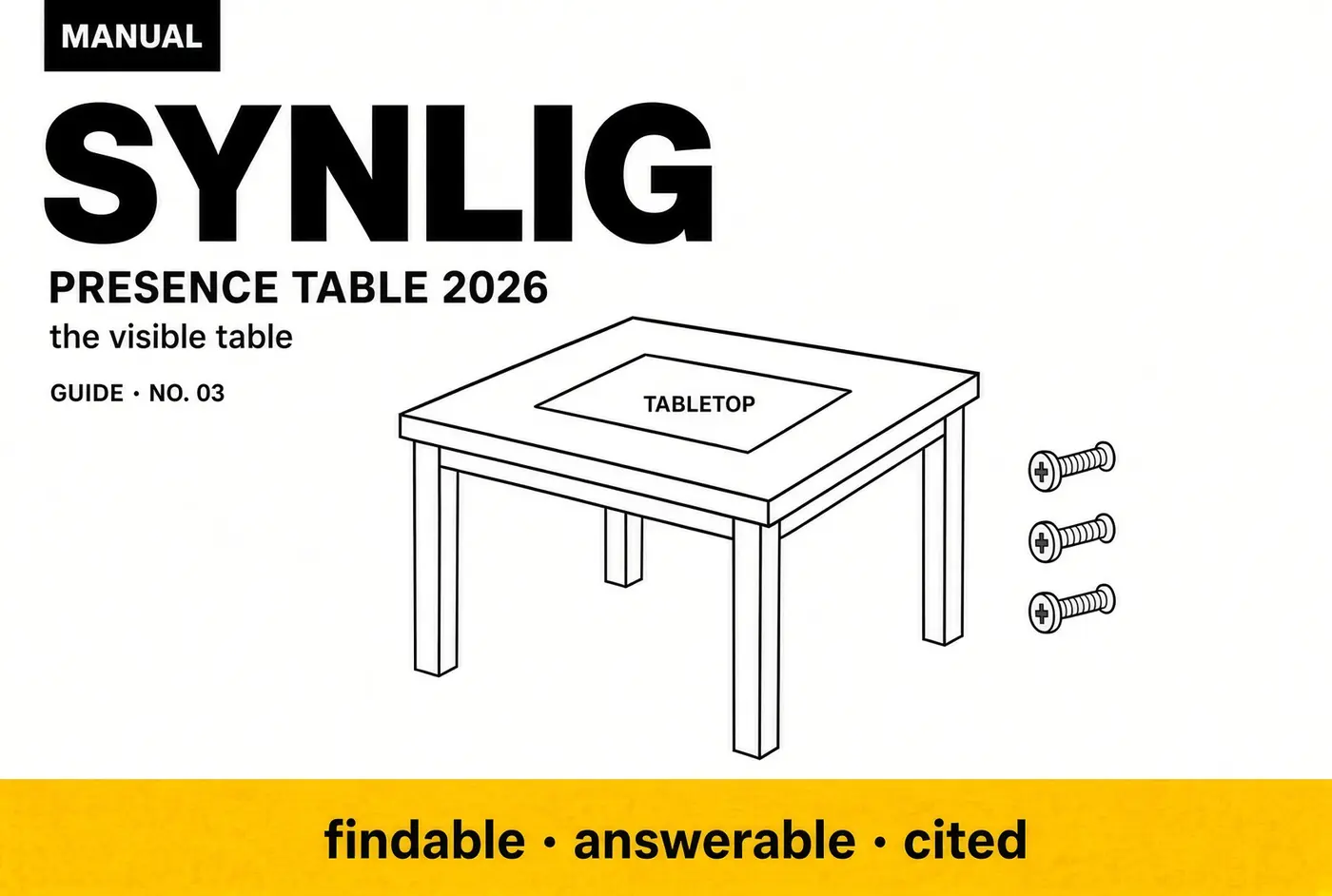
You open the box and the catalog shows a handsome tree: SEO, AEO, GEO, AIO, SXO. Twenty-five screws, all the same size. A diagram that fits on Instagram. Then you try to eat off it and the glass draws an oval.
That is not furniture. That is the catalog photo of furniture. SYNLIG is the actual table: four legs, a tabletop you level every week, and only three screws that bear weight. The rest of the bag — the acronyms, the stray schema, the miracle file — is the spare pack IKEA throws in so you feel busy.
What is in the box
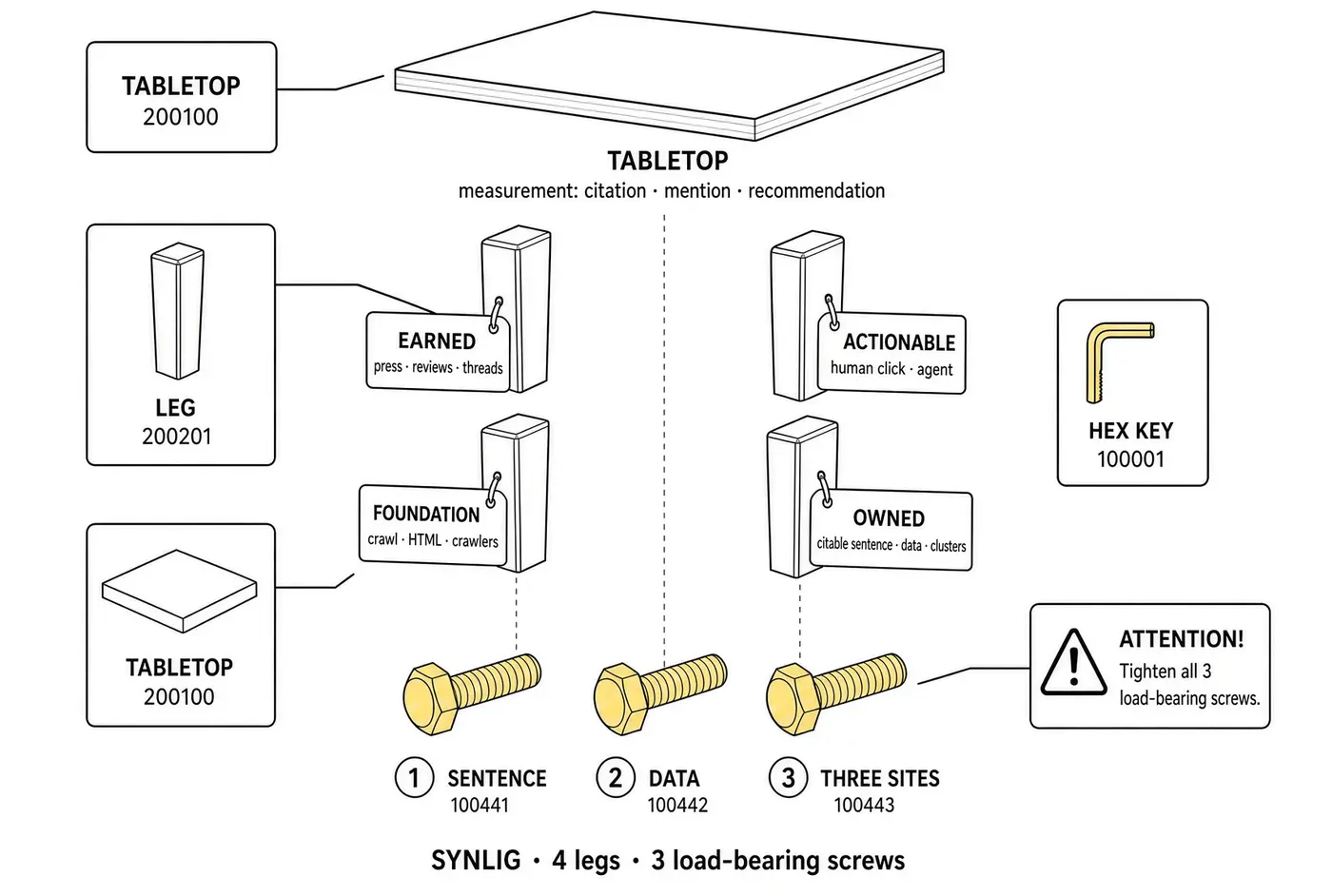
| Part | Job | If it is missing |
|---|---|---|
| Foundation | Crawling, source HTML, search crawlers, a page that may show a snippet. | Everything else is theater. The model cannot sit down. |
| Owned | Pages that answer in the first 40–60 words, a first-party number, real topic clusters. | They extract your competitor. |
| Earned | Press, reviews, comparisons, threads, listings. What the model already cites when the source is not you. | You are a well-written brochure. |
| Actionable | The human who clicks and the agent that fills the form. | They name you and nothing happens. |
| Tabletop | A fixed prompt set. Citation, mention, recommendation. How they describe you. | You tighten blind. |
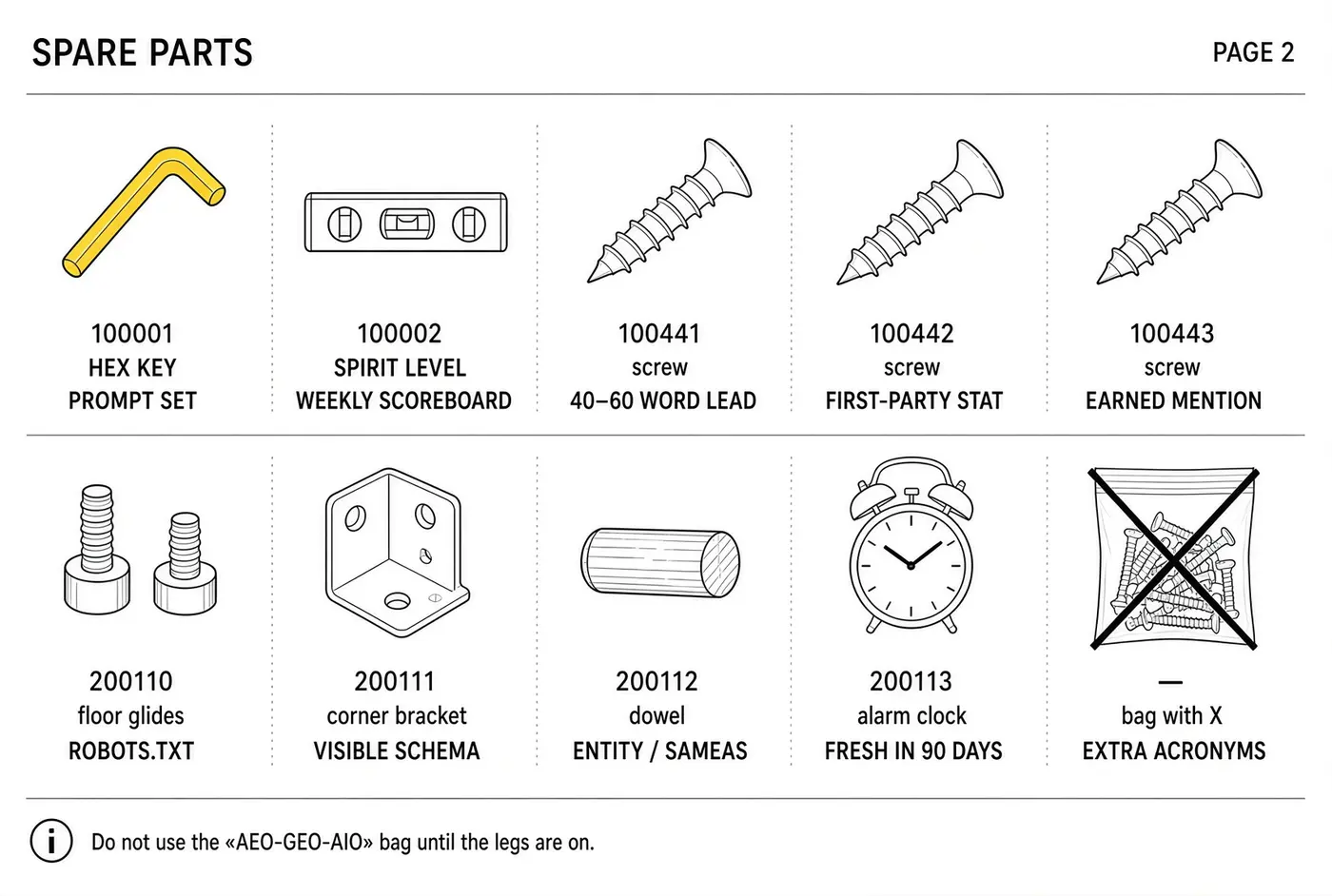
Tools (the hex key and the level)
You do not need the whole workshop. You need a key that tightens and a level that says whether the table wobbles. The market sells marble drills for hanging a picture.
For tightening
| Tool | What it is for | Shop note |
|---|---|---|
| A sheet with the prompt set | The real hex key. Without it you do not have furniture. You have hunches. | A spreadsheet is enough. Fifty rows as a floor; 80–200 if someone will run them. This guide’s CSV has the columns. |
| The engines themselves | ChatGPT, Perplexity, Gemini, Claude, AI Overviews. | Do not outsource the week-zero run to a dashboard. |
| View source (JS off) | Confirm the answer block exists in the initial HTML. | If it appears only after hydration, the crawler will not trust it. |
| Schema validator and Rich Results Test | Markup that mirrors what a reader can see. | Do not invent FAQ pairs the page does not show. |
| Search Console | Indexation, snippets, and AI Overviews or AI Mode impressions where they exist. | Clicks are still bundled. Do not treat it as your only citation board. |
So the table does not wobble
| Tool | What it is for | Shop note |
|---|---|---|
| One AI-visibility tracker | Run the set every week without burning an intern. | Profound, Peec, Otterly, Scrunch, Evertune, Ahrefs Brand Radar. Pick one. Freeze engines and prompts. |
| Server logs or Cloudflare | Do OAI-SearchBot, ChatGPT-User, Claude-SearchBot, and PerplexityBot get through? | Keep training (GPTBot, ClaudeBot, Google-Extended) as a separate policy from live retrieval. |
| G2, Capterra, or the directory in your vertical | The earned leg the model already looks at. | Complete profile, recent reviews, canonical name. |
| A 90-day calendar on the same sheet | Freshness. Pages that already get cited get a retouch. | Visible date. Figures with a year. |
| PageSpeed / CrUX and the form on a phone | The actionable leg. | If a human or an agent trips on the first field, that screw is loose. |
Assembly
Foundation. Drill before you decorate.
Open /robots.txt. Let search and fetch agents through. Do not kill a citation because you copied a template that blocks bots.
- Allow:
OAI-SearchBot,ChatGPT-User,Claude-SearchBot,Claude-User,PerplexityBot. - Decide training separately:
GPTBot,ClaudeBot,Google-Extended. - Remove
nosnippetandmax-snippet:0from URLs you want cited. - Turn JS off for a minute. If the first paragraph vanishes, there is no leg.
Done when: a priority URL reads in full in view-source and is still snippet-eligible.
Tabletop. The before picture.
Do not start by rewriting. Start by hearing what the model says today when a buyer asks.
- Pull questions from sales calls, tickets, and People also ask. Group them: educate, shortlist, compare, post-purchase.
- Lock the set. Adding prompts on a whim is changing the tape measure mid-job.
- Run each one on the engines that matter. Log: does your URL appear? Does the brand? How are you described? Whom do they recommend?
Sheet columns (they ship in data/synlig-tablero.csv):
date | engine | prompt | stage | prompt_language
cited_url | brand_named | portrayal | recommended | earned_source | notes
Done when: that sheet has a date on it. It is the only before that counts.
Owned leg. Fifteen tables, not the warehouse.
Pick the 15–20 URLs that decide the sale or the authority claim. The archive can wait for another Saturday.
On each one: an H2 phrased as a real question; under it, 40–60 words that stand alone; three bullets with a figure and a named source, or a table if the prompt compares; a FAQ of four to six questions someone has actually asked; Article / Organization / Person / FAQPage schema that copies what is visible; consistent sameAs.
Illustrative sample block; illustrative figures, not study results (steal the hole, not someone else’s thesis)
H2. What do you actually have to cover in 2026 to have real online presence?
Four jobs and a tabletop. Foundation is whether the page exists for the crawler. Owned is a sentence that can be quoted without the paragraph above it. Earned is the mention on sites the model already trusts. Actionable is what happens when a human — or an agent — arrives. Without a fixed prompt set, the rest is varnish: you cannot tell if the table wobbles.
- A 40–60 word answer block under a question H2 lifted median mention rate by 6 points in 3–5 weeks across 140 tracked brands.
- Three new mentions on trusted third-party sites lifted it 9 points in 6–10 weeks: slower, heavier.
- Markup that does not mirror visible content does not invent the citation. It confirms entities.
Done when: a stranger can read the first paragraph over the phone and does not need the H2 above it.
Screws 1 and 2. Sentence and data.
This is where the varnish ends. Every priority URL carries:
- 100441 Sentence. A claim that can be cited with no context. Not “in an increasingly complex world…”
- 100442 Data. A number the competitor does not have: your sample, your cut, a date. If it does not exist, make a small one. Otherwise there is no screw.
Markup replaces neither. It confirms entities. It does not invent answers.
Done when: you can point, on each page, to the sentence and the number you would want pasted into a Perplexity reply.
Earned leg and screw 3. Three sites that are not yours.
The model triangulates. A well-written owned page is a brochure. Three mentions on sites that already feed answers in your category are furniture.
- List the domains that show up in your baseline when people ask for a shortlist.
- Win three new placements in that pool: a comparison, a review, an editorial piece, an updated listing, a thread you did not write.
- Use the same canonical name as your
Organizationschema.
This does not wait for “the PR phase.” It runs beside step 2. It takes longer (6–10 weeks) and it is the screw that bears the most weight. A second job turns it: whoever walks newsrooms, listings, or communities. If the same writer parks it “until there is budget,” the table wobbles with elegance.
Done when: the same shortlist prompt returns something of yours and something off-site that names you.
Actionable leg. In case someone sits down.
The human who arrives from a citation is hotter and less patient. The agent never sees the hero. It reads headings, buttons, and forms.
- The first viewport keeps the snippet’s promise.
- One primary next step on high-intent pages.
- A short form. Test it on a phone.
- Real headings, real buttons. Nothing essential that lives only on a canvas or behind a login as the first wall.
Done when: a stranger — and, if you can, a test agent — completes the action without pinging you on Slack.
Level it. The glass of water.
Three to five weeks after the rewrite, and again at eight, run the same set. Do not switch tape measures.
- Rewritten URLs should move mention first.
- If they do not: the block is not extractable, or the prompt was not that page’s prompt, or the foundation was missing.
- If they cite you and describe you as “just another,” the earned screw and the entity are loose. You do not need another H2.
Done when: you can say, with a date, which lever moved which engine.
Maintenance. Every 90 days, not every algorithm.
Pages that already get cited get a retouch: date, figure, example. Pages that do not get a review or get left alone. Publishing more does not lengthen a short leg.
Done when: tabletop URLs show a last-updated line and a number that is not last year’s.
If the table wobbles
| Symptom | Loose leg | What to tighten |
|---|---|---|
| Nobody cites you and view-source has no answer | Foundation | Robots, initial HTML, snippet eligibility. |
| You are indexed and not extracted | Owned / sentence | 40–60 words under a question H2. Cut the preamble. |
| You are extracted and not recommended | Earned | Three sites. Not another FAQ. |
| They name you as “one of many,” or group you wrong | Entity | sameAs, About, off-site listings, a named framework. |
| They cite you and nobody converts | Actionable | First-screen promise and one next step. |
| It rose for a month and fell | Freshness | Step 7. Pages left alone for a quarter lose the citation. |
Assembly time, without the romance
- Steps 0–1: one or two weeks.
- Steps 2–3: three to five weeks on the URLs that decide. Owned mention usually moves here.
- Step 4: six to ten weeks. Start on Tuesday, not “in phase three.”
- Step 6: at eight weeks you know whether the table survives dinner.
The difference between the catalog drawing and this table is blunt enough to use: the screw that holds is not the markup. It is a sentence that can be quoted with no context, a number nobody else has, and three third-party sites saying the same thing you say. Everything else is paint.