
There is always something better out there: a faster service, a sleeker interface, a better-funded competitor, or that one feature you somehow did not think of first. That is what markets do. Artificial intelligence has merely accelerated the cycle. What once differentiated a company for years can now be reproduced in months; sometimes in weeks. Competitive advantage comes with an increasingly short shelf life.
So, the interesting question is not how to make sure no one ever builds something better than you.
They will.
The question is: why would your customers stay when they do?
I think about this often, and not only as someone who provides professional services. I think about it as a consumer.
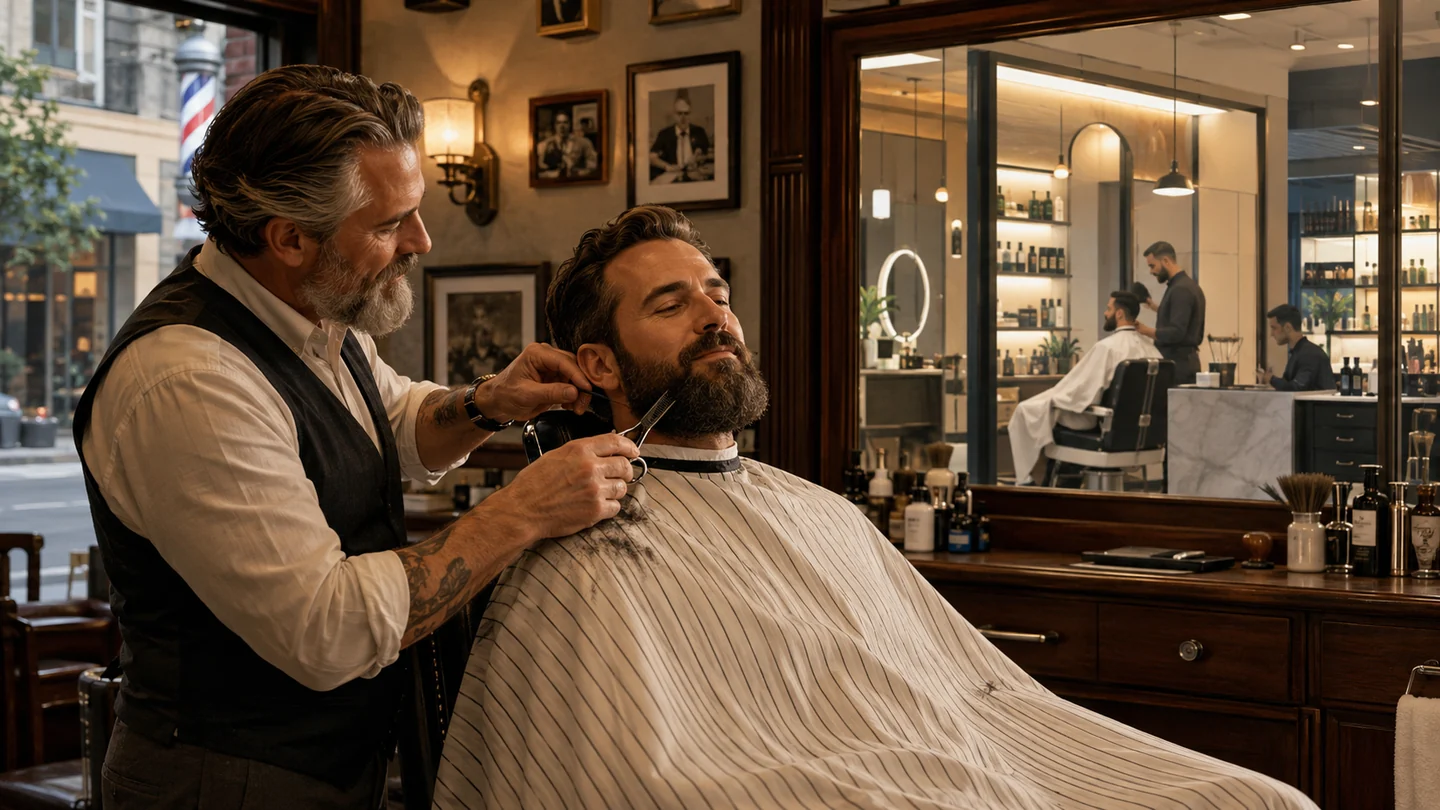
Consider something considerably more mundane: my barber.
I am quite sure—because I have seen them—that there are more sophisticated barbershops I could go to. Places with more considered interiors, smoother booking systems, hotter towels, and an impressively elaborate assortment of things someone has decided should happen to a man's face while he waits his turn.
And yet, for years, I have kept going back to the same guy who trims my beard.
Why?
Because I am comfortable there.
He knows me. I know him. I know what to expect. More importantly, I know that if something goes wrong, he will make it right. If he is running late, we will work it out. If one day I want something slightly different, I do not have to start the relationship from scratch or explain myself all over again.
Between us there is a small reserve of trust.
That may sound overly sentimental for something as ordinary as having your beard trimmed. It is not.
That feeling is part of what I am buying.
We tend to describe purchases as transactions: I give you money; you give me a product or perform a service. Economically, that is accurate. As a description of the experience, it is incomplete.
There is an experience to buying something.
There is an experience to hiring someone.
And there is an experience to discovering that something has gone wrong and wondering whether the company on the other side is going to help fix it—or start looking for the paragraph in its terms and conditions explaining why, technically, it is not their problem.
Customers remember that experience. They remember whether someone listened. Whether an email felt as though it had been written by a person who had actually read the one before it. Whether a mistake was acknowledged or disguised. Whether they were treated as a relationship worth preserving or as an invoice that had already been paid.
And this is where much of the current conversation about artificial intelligence and business misses something important.
Companies are, understandably, racing to incorporate AI into their products, services, and operations. We are doing it too. The technology is extraordinary, and pretending otherwise would be absurd. It can make a business faster, more capable, and far more precise. It can eliminate tedious work, improve analysis, and allow small organizations to do things that until very recently required enormous teams.
But there is a temptation to confuse more capability with more value.
And, worse, to confuse personalization with personal care.
A system can know your name, remember your last purchase, anticipate your next question, and compose an impeccably courteous response in milliseconds. None of that necessarily means you feel that someone is looking after you.
Those are different things.
As more companies gain access to technologies that are extraordinary and, at their core, increasingly similar, technological sophistication will stop feeling extraordinary on its own. Interfaces will improve. Responses will get faster. Automation will become ubiquitous. The polished experience that feels exceptional today will become tomorrow's baseline.
And that will make the stubborn human part of the relationship worth more, not less.
That matters especially in professional services. The barber's logic applies even more strongly when what you are selling is judgment.
A client walks in with a logo he has drawn on a napkin, and he is completely in love with it. The easy thing is to execute it beautifully and send the invoice. Our job is something else: understanding what he is trying to achieve, whom he needs to convince, what business sits behind it, and in which market it will have to hold its own. And, every now and then, explaining to him, with the appropriate diplomacy, that the person he needs to win over is not him. It is his customer.
If our contribution ends with the deliverable, we have not done our job well.
That requires something technology cannot manufacture by adding another feature: a relationship in which telling the truth is part of the service.
It also explains why expertise and knowledge should not appear only after someone signs a contract. We publish essays, tutorials, and research openly because sharing what we know is one way of building trust. Before asking someone to hire us, I would rather give them enough evidence to decide for themselves whether we deserve to be hired.
And if they ultimately do, that trust creates an obligation.
Not the obligation to be perfect. We will not be. No one is.
The obligation is something else: to be there when it matters.
In English, there is already a perfectly good phrase for it: to have someone's back.
It means not disappearing when a problem appears. Fixing a mistake when you make one. Telling a client when they are about to make one. And when the commercially convenient recommendation conflicts with the one you would make if your own money or reputation were on the line, choosing the latter.
Sometimes I reduce it to an even simpler rule: I do not want to sell a client anything I would not comfortably recommend to someone I care about.
That is not customer service.
It is a way of doing business.
And I suspect it will become more valuable precisely because of artificial intelligence, not in spite of it.
Our technology division (opens in a new tab) sums it up in two words: Agentic. Human.
The pause matters.
We are not interested in pretending the technological transformation is not happening. We want the agents, the automation, the models, and the speed. But all of it should serve a human purpose.
The goal is not to automate caring about your customers.
It is to automate enough of everything else that you have more capacity to care for them properly.
And you should keep trying to outperform your competition. Of course you should. Trust is no excuse for mediocrity, and customer loyalty should never be mistaken for permission to stop improving.
But customers do not experience companies as feature-comparison charts. They experience what it feels like to deal with them. And in markets increasingly full of excellent products, sophisticated technology, and remarkably similar promises, that feeling may end up being one of the few advantages that cannot be copied and pasted.
Because sooner or later, your competition will have a better feature. Someone will offer a lower price. Someone will launch a prettier interface. Someone will deliver a more dazzling demo. Someone will have hotter towels.
And still, if you have done your job, they will keep coming back to the same place.