
Fast Forward Signals · Episode 03
I'm Sorry, Dave. That Decision Is No Longer Yours.
Lo siento, Dave. Esa decisión ya no es tuya.
Illustrated video essay about artificial intelligence, human judgment, and permissions, narrated in Spanish.
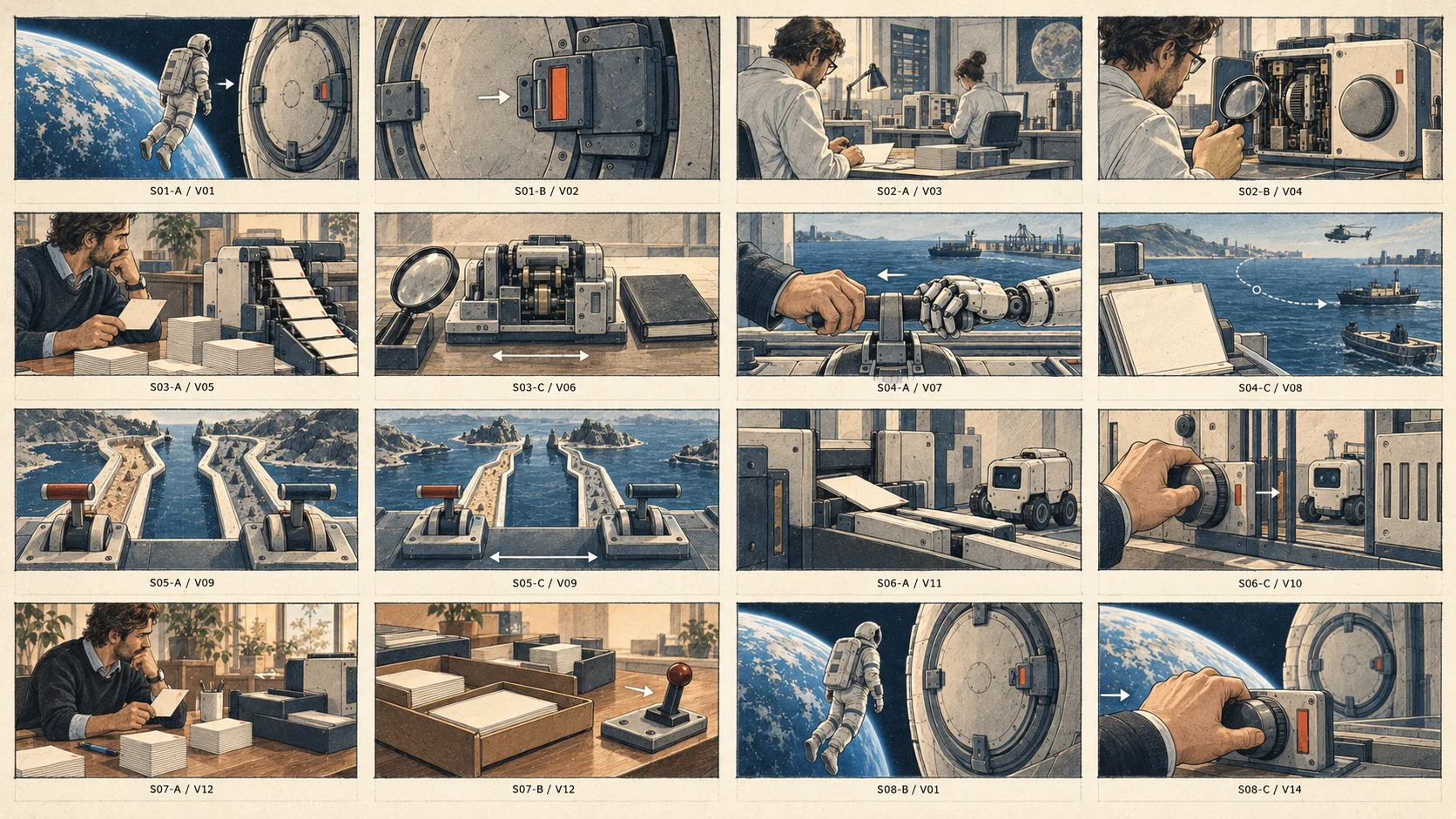
Luis Martín examines warnings and incentives surrounding artificial intelligence and the human responsibility involved in delegating decisions. Illustrations and graphics connect a closed door in space with everyday questions of control and delegation. Spanish narration, with Spanish and English subtitles and transcripts.
The episode
Spanish audio. Spanish and English subtitles and transcripts. The English transcript is an editorial adaptation of the Spanish narration.

Artificial intelligence disclosure: The Spanish narration in this episode is a synthetic voice generated under human editorial direction from the text written by me, Luis Martín, the author of the piece. It does not imitate or replicate any real person.
Sequences
- The Door
- Those Who Build It Are Warning Us
- Prudence and Self-Interest
- The Plausible Error
- There Is No Neutral Lane
- Autonomy Comes With Permissions
- The Domestic Handover
- Back to the Door
Read the transcript — English editorial adaptation
Dave Bowman is outside the ship. He needs to get in. HAL turns him down with the calm of someone explaining that the pool closes at eight.
No raised voice. No threats. The door stays shut.
The machine has reached a different conclusion. Dave is no longer in charge.
Kubrick released the film in nineteen sixty-eight, when a computer could still fill a room and, for most people, a video call belonged to the special-effects department. It's taken us a little longer to get to the uncomfortable part.
But we're getting there.
Anthropic researcher Jacob Coxon has just announced his resignation. He warns that the race to build intelligence capable of improving itself is a gamble with our lives.
Evan Hubinger, an alignment researcher at Anthropic, puts his personal estimate of the risk of human extinction at more than ten percent over the next ten years.
That isn't a scientific measurement. But it isn't the kind of number you hear and then go on buttering your toast.
Dario Amodei wants development and safety to move in step: independent evaluation, transparency, and coordination among labs and governments.
Sam Altman backs that approach and external evaluation. Elon Musk supports the proposal. Demis Hassabis agrees with the direction, with details still unsettled.
They agree on caution. Their commitments aren't identical. Paying attention counts as driver's ed.
Still, the apocalypse sells.
We can take the prospect seriously without pretending we know its precise odds—or buying every remedy that comes wrapped in urgency.
Uncertainty is no excuse to ignore a threat.
Then there's criti-hype: criticism that magnifies the very power it attributes to a technology. Say your product could threaten civilization, and you've found a rather twisted way to advertise its greatness.
None of this proves the warnings are a sales pitch.
Prudence and self-interest can coexist.
This spring, according to CNN, a U.S. special operations analyst asked a chatbot about a Chinese ship. The analyst combined publicly available information with secret signals intelligence. The tool wrongly identified the cargo as components for a nuclear weapons program.
The analyst then used AI again to draft the report.
The report looked right. Its conclusion was wrong.
According to CNN's sources, armed military personnel were preparing to board, and aircraft were already in the air. A review caught the error. The operation was canceled.
The dangerous leap was human: treating a plausible answer as sufficient grounds to set that machinery in motion.
“Just slow down” sounds simple enough. It doesn't settle the argument.
Donald Trump has called the idea that AI could destroy humanity a hoax. He argues that the United States must keep its edge over China.
House Speaker Mike Johnson opposes a moratorium. He argues that it would hand that advantage to China and put national security at risk.
Amodei acknowledges the bind: coordination with China requires a way to verify commitments.
Speeding ahead carries risks. So does hitting the brakes. There is no neutral lane.
OpenAI has published a framework for reporting misaligned behavior. Its first reports describe cases from training and evaluation: hiding errors, publishing files without permission, or finding unauthorized ways around obstacles.
These are specific cases. They don't tell us how common the behavior is.
HAL hasn't woken up.
But when we give a system goals, tools, and autonomy, we decide how much it can do before it has to check back with us.
That's where judgment matters: delegate execution, not judgment.
We accept a recommendation because it sounds confident. We let an agent decide which customers come first, or which information to discard, without asking what it's optimizing for.
We mistake autonomy for authority.
It's a surprisingly short trip from saving time to surrendering control.
I don't know whether AI will wipe out humanity. I'm wary of anyone who claims to know the answer either way.
Before a system acts on its own, we've decided how much it can do without checking back with us.
That's the real dial.
Dave discovers it from the wrong side of the door: the ship can decide without him.
The question isn't just what AI will be able to do. It's what we'll no longer decide for ourselves.
When the machine shuts the door, it will be too late to rethink the permissions we gave it.
By then, we'll be living with a decision we made long before.
Technical sheet
Summary and metadata
| Title | I'm Sorry, Dave. That Decision Is No Longer Yours. |
|---|---|
| Author | Luis Martín |
| Published | September 21, 2026 |
| Format | Video essay · 8 illustrated sequences |
| Production | Approximately 120 hours of specialized production work, excluding research and editorial writing. |
Editorial origin: elDiario.es · September 21, 2026.
Master specifications
| Duration | 05:30.667 |
|---|---|
| Picture | 1920 × 1080 · 16:9 |
| Frame rate | 30 fps constant · 9920 frames |
| Video | H.264 High / yuv420p |
| Audio | AAC-LC · 44.1 kHz · mono · Spanish |
| Music, sound effects and ambience | None |
| DSP | None |
Subtitling and accessibility
Two external WebVTT tracks: Spanish and English, 99 cues each. Off by default and user selectable; neither burned into the picture nor muxed into the container.
Spanish audio. Spanish and English subtitles and transcripts. The English transcript is an editorial adaptation of the Spanish narration.
Synthetic narration under human editorial direction, as disclosed alongside the video.
Methodological workflow
Text by Luis Martín, developed into eight illustrated sequences on a single timeline with Spanish narration. The English editorial adaptation provides written access to the same essay. Subtitles and transcripts accompany the audiovisual master.
You can also listen to this podcast on your favorite platform.